
From Barriers to Belonging: Building an artistically inclusive Tasmania
Written by Morwenna Collett
All image credits: Stevie Battese
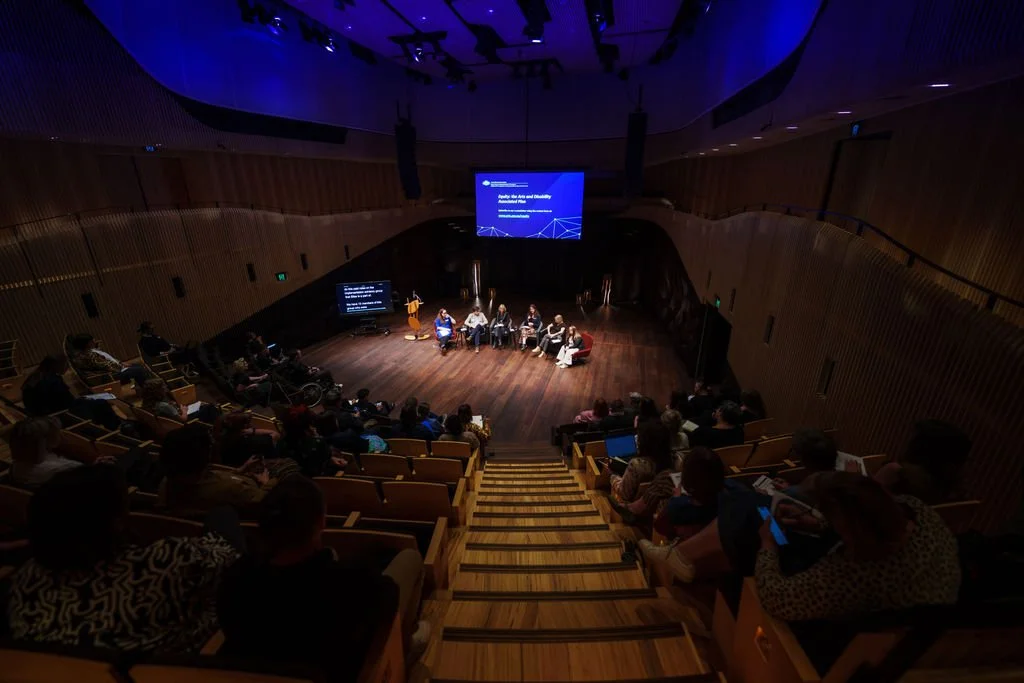
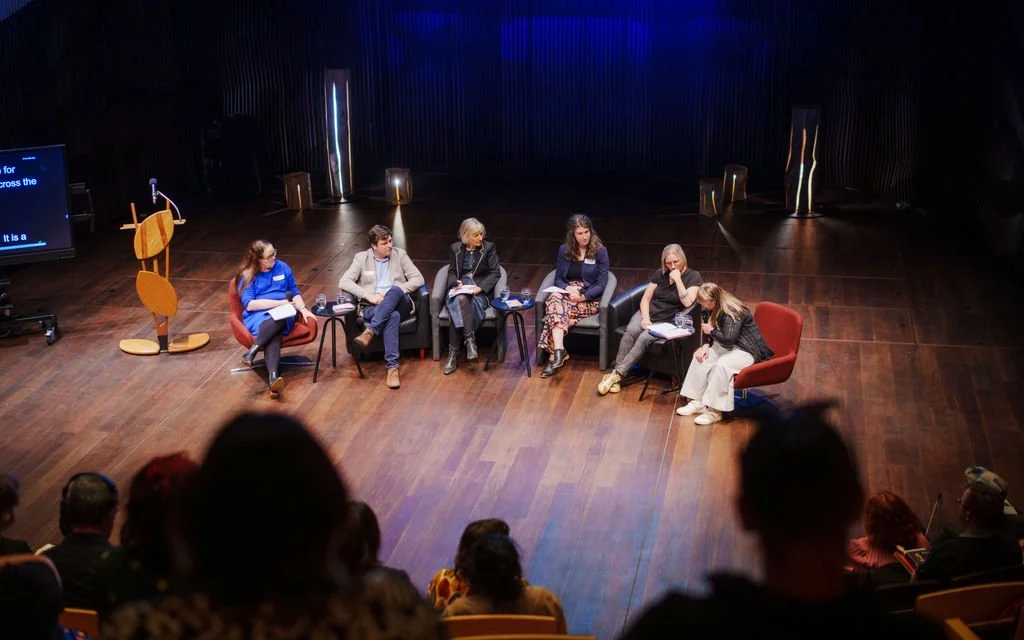
Image description: A wide-angle view of a modern auditorium shows a panel discussion taking place on stage under blue lighting. The audience is seated in tiered wooden rows, with accessibility features such as integrated wheelchair spaces visible.
Over the past 15 months, Building an Artistically Inclusive Tasmania has been delivered as a strategic initiative for Arts Tasmania, designed to strengthen access, inclusion and disability equity across the state’s arts and cultural sector. Convened and led by Access Consultant Morwenna Collett, this work has centred disabled artists and arts workers as leaders - supporting organisations to build confidence, skills and practical approaches to accessibility that move beyond compliance and toward cultural change. At its heart is the belief that Tasmania’s arts ecology is strongest when access is embedded from the outset, and when disabled artists are recognised not only as participants in conversations, but as leaders shaping them.
This initiative culminated in From Barriers to Belonging – An Equity in the Arts Forum, held on 5 February 2026 at The Hedberg in Nipaluna/Hobart. The forum was delivered by Morwenna and her team (Sharifah Emalia Al-Gadrie and Julia Loersch) in partnership with Arts Tasmania and the University of Tasmania. The forum was co-designed with a steering committee of Tasmanian disabled artists: Elise Romaszko, Kelly Drummond Cawthon, Laura Sheedy, Duncan Meerding, Emily-Rose Wills and Emma Bennison. The day opened with a Welcome to Country from Palawa knowledge keeper Linton Burgess, followed by opening remarks from Acting Deputy Secretary, Creative Industries, Sport and Visitor Economy Andrew Smythe and Tasmania’s Disability Commissioner Catherine Whitington, grounding the event in leadership, accountability and shared purpose.
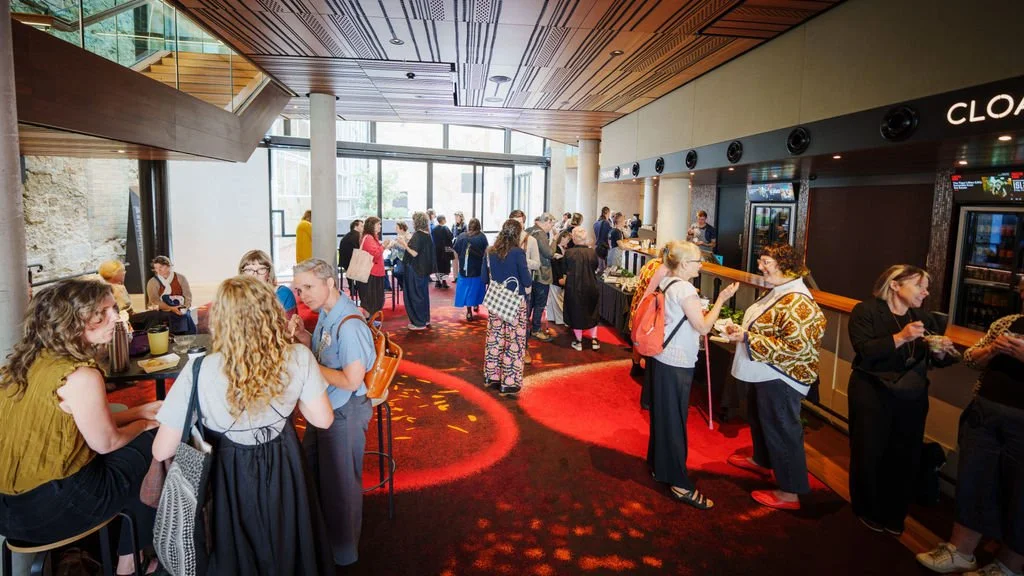
Image description: A bright foyer space shows people mingling and chatting, with small groups gathered around high tables and a bar counter. Natural light streams through large windows, creating a warm and lively atmosphere.
A gathering shaped by artists
The forum sold out quickly, with artists and organisations travelling from across the state to attend. Gathering in-person felt particularly important, creating space for conversation, connection and shared learning - however an online livestream option was offered to enable others to join virtually. Participants included independent artists, regional organisations and national speakers from Creative Workplaces, Arts and Disability Network Australia and the Office for the Arts, demonstrating the growing momentum around disability equity both in Tasmania and nationally.
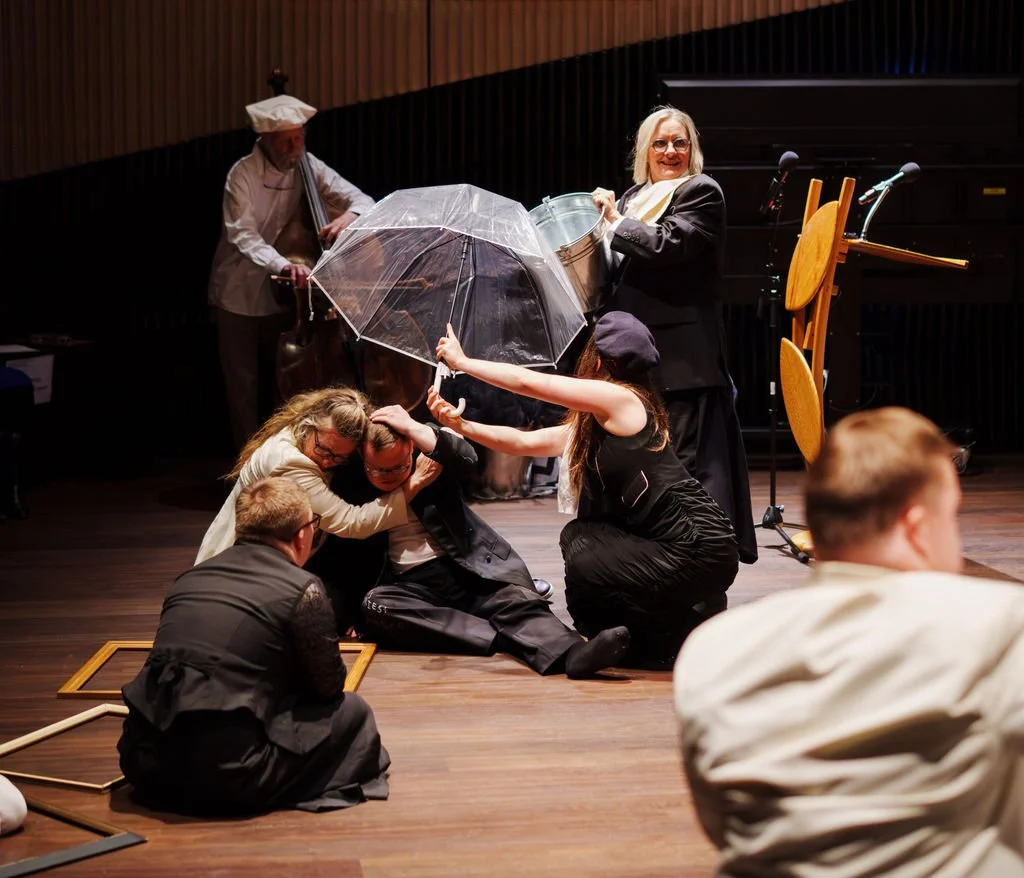
Image description: On a stage, performers enact a dramatic scene: several people crouch together under a clear umbrella while another stands holding a metal bucket above them. In the background, a musician with a double bass and a lectern suggest a theatrical or live performance setting.
Accessibility was intentionally embedded throughout the event: captioning, audio description, a quiet space, a visual story, a livestream option and flexible participation options were provided. Art itself was central to the day - with an installation of works by Duncan Meerding framing the stage, an embodied movement experience by Luke John Campbell grounding participants at the beginning of the day, a performance by Second Echo Ensemble, weaving and movement sessions, and a short film screening from Bus Stop Films. The event also centred strong Palawa representation across artists, speakers and other roles, reinforcing how intersectionality shaped both the design and tone of the gathering. The day included plenty of space for breaks and informal moments to connect with colleagues, including a post-forum networking drinks.
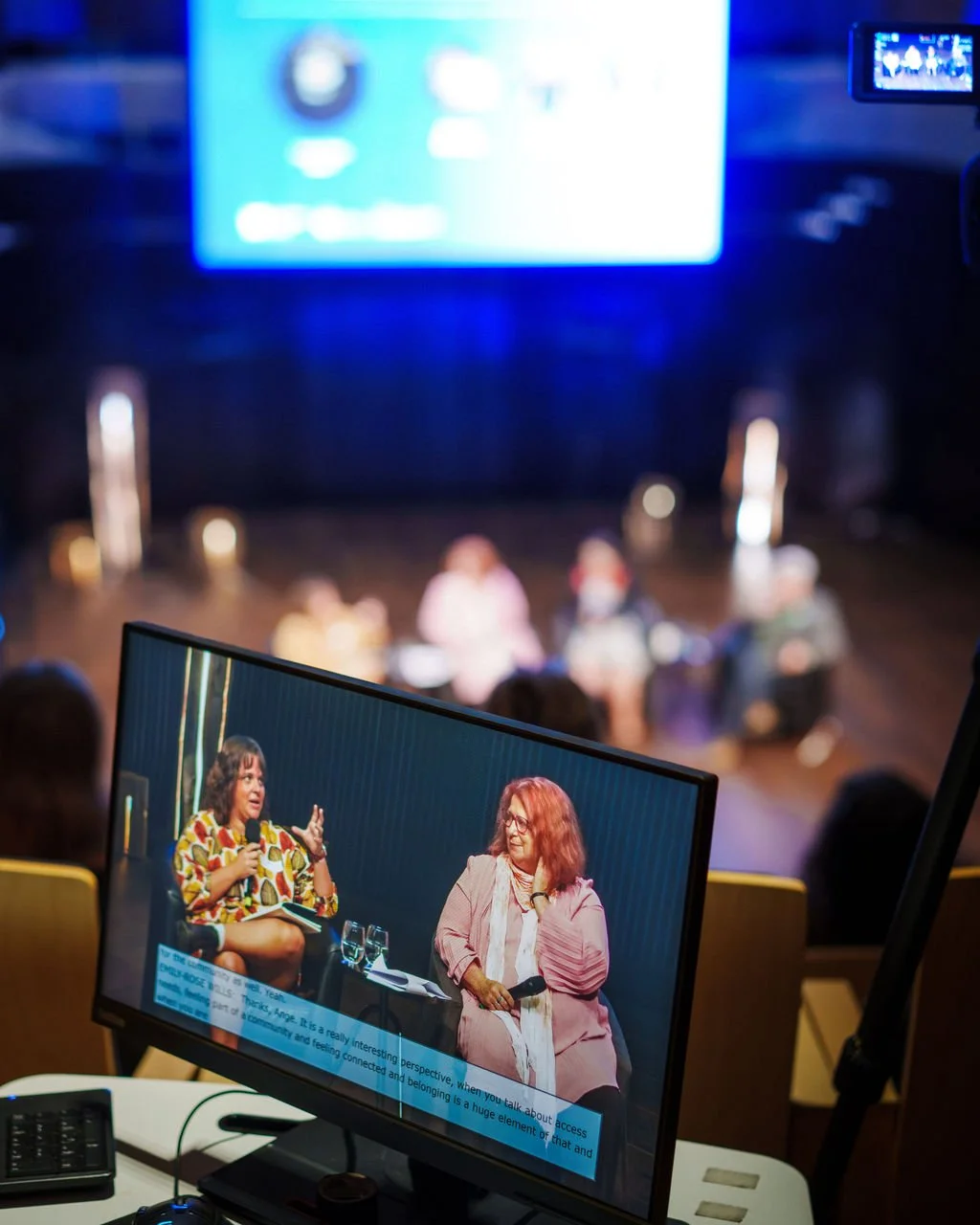
Image description: a close up of a screen with live captioning of two speakers from the tech desk.
Session reflections
Session 1 — Access barriers and solutions
The opening session established the tone for the day by centering lived experience. Chaired by Emily-Rose Wills, the panel invited artists to speak directly about the realities of working in the sector; not from theory, but from practice.
As Emily-Rose framed early on:
“Access is often talked about in abstract or policy terms. Today we are grounding that conversation in lived experience… to consider how everyday decisions either open doors or quietly close them.”
Stories shared during this session were at times funny, at times painful, and always deeply human. Vision impaired artist Duncan Meerding spoke about the lingering impact of assumptions around disability, recalling:
“ I got in the finals of a competition… and this guy came up… and said, ‘Hey… I could poke my eyes out and start winning competitions as well.’ … One negative comment can counterbalance ten positive.”
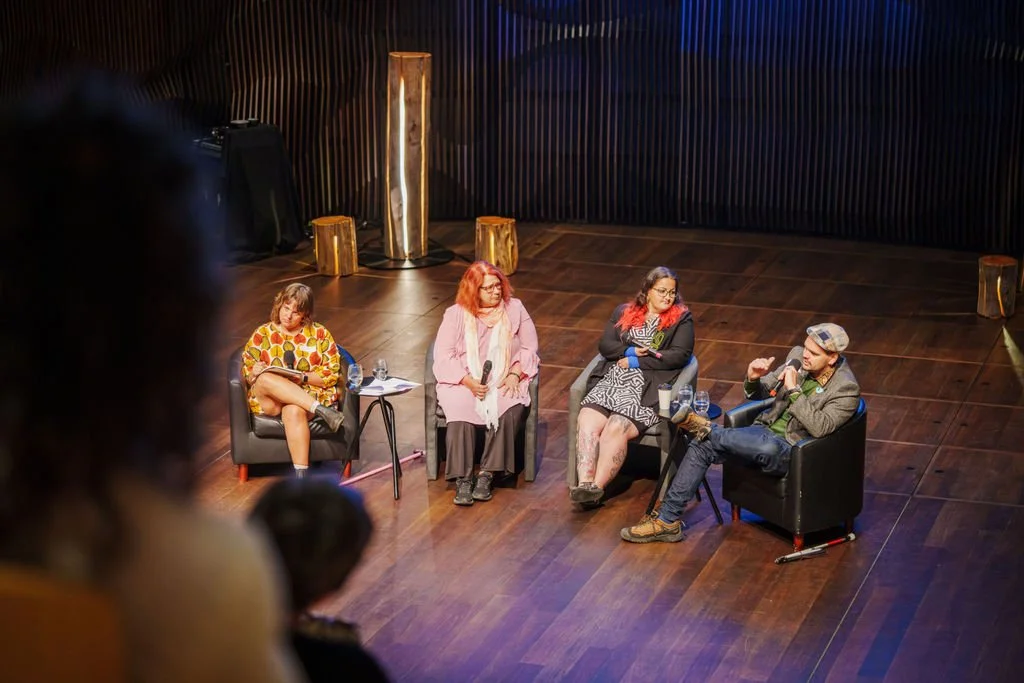
Image description: A panel discussion on stage with four people. The man on the far right is speaking into a microphone.
Bianca Templar’s reflections highlighted the everyday assumptions faced by people with non-visible or intersecting identities, capturing the absurdity and fatigue of having to explain disability constantly:
“You’re either there as a woman, or an Aboriginal, or you’re there as a disabled person to talk about being disabled. You can’t be all three. You can be one. But I am all three. And all three come together to inform who I am.”
Together, these stories reinforced a key message: access is cultural as much as it is structural. The panel demonstrated that disabled artists are not asking to be included in existing systems, they are actively reshaping what those systems can become.
Session 2 — Sharing practice, stumbles and learning
Session two shifted the focus toward organisational practice, with speakers openly discussing both successes and challenges. Chaired by Adam Wheeler from Assembly 197, the conversation created space to share “stumbles” or moments where things hadn’t worked perfectly, but where learning had led to stronger outcomes.
Adam encouraged participants to engage with accessibility as a practice built through consistent, incremental progress rather than grand gestures or fixed checklists:
“Something that I’ve tried to adopt personally, professionally, artistically, is the idea of the small wins. If there’s one small win a day, that’s seven in a week, 30 in a month, 365 a year.”
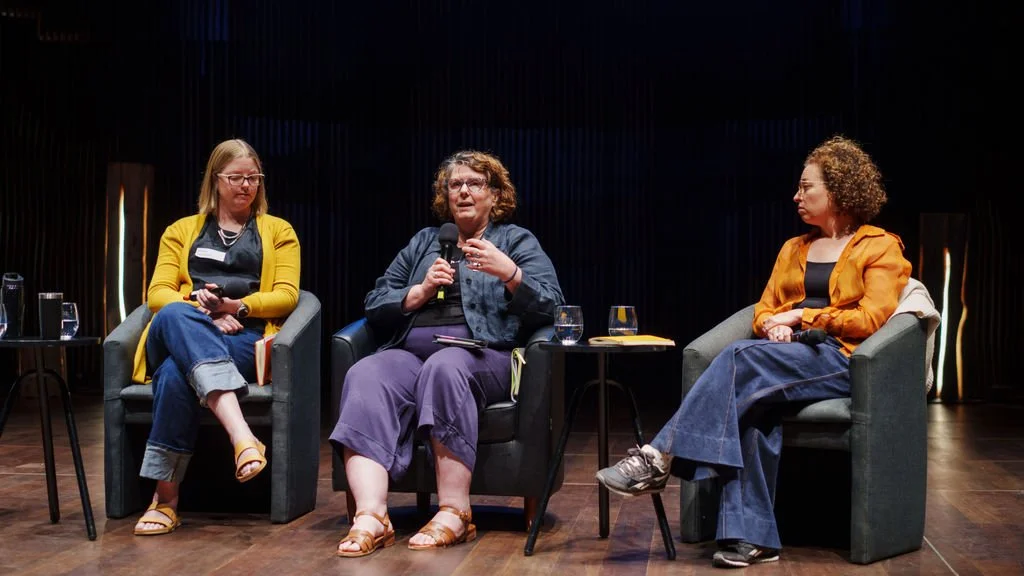
Image description: Three women sitting on stage for a panel discussion. The woman in the middle is holding up the microphone and the other two women are looking toward her.
Panelists emphasised the importance of asking questions and genuinely listening. Allison Campbell from Burnie Arts Centre shared a practical question she often asks through her practice:
“What can we do to make this experience better for you? This is a rare question.”
Louisa Gordon from The Unconformity reflected on the value of openness in building sector confidence:
“We don’t celebrate our wins or talk about our challenges enough… A day like this is so important to connect.”
The honesty of this session helped shift the conversation away from perfection toward continuous learning, signaling an important step in building long-term change. As Allison Campbell emphasised, “Frank and open discussion is only going to be of benefit.”
Session 3 — Learning and connecting
The third session offered participants multiple ways to engage, through pairing practical discussions with embodied activities like a movement session led by Second Echo Ensemble and weaving, led by Palawa artist Takira Simon-Brown to ensure the day didn’t become overly “talk heavy.” Conversations explored relaxed performances, non-visible disability, access riders and building trust with communities.
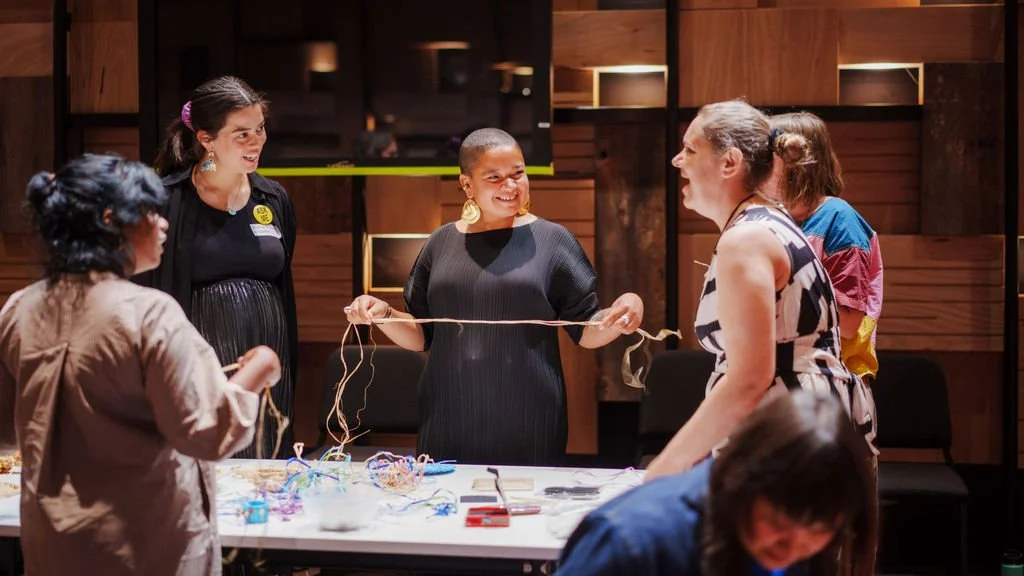
Image description: A group of people smiling and chatting with each other. The woman in the middle is holding out a long piece of raffia, as if to begin weaving. There is coloured raffia on the table in front of them.
A recurring theme was that access is relational. Erica Campbell-Graham from the Theatre Royal articulated this clearly:
“Accessibility is customer service and customer service is accessibility. It’s welcoming people into spaces. It’s about trust.”
Nicole Winspear from Performing Lines reinforced that access services alone are not enough:
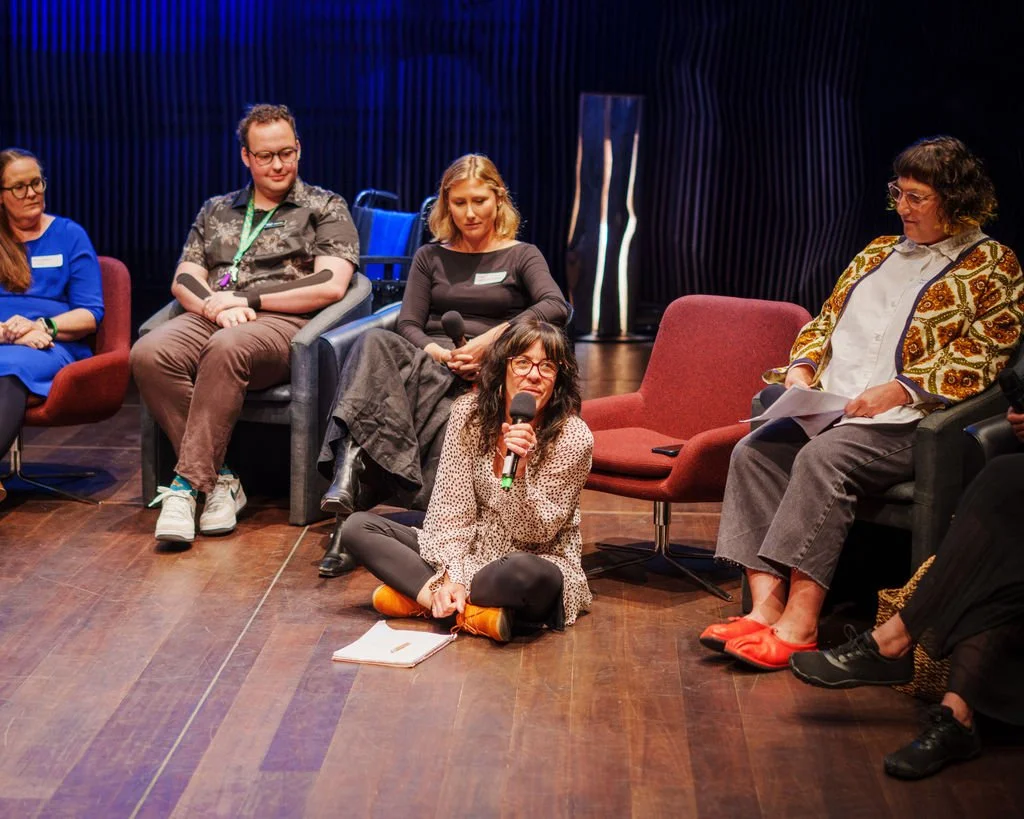
“Just putting in services isn’t all the work… you need to build the relationship so people know what’s there.”
Laura Sheedy’s contribution brought the focus back to simple, practical language:
“The question to ask is ‘how do you work best?’ — right from that first interaction.”
These conversations highlighted how small shifts in communication and practice can dramatically increase a sense of belonging.
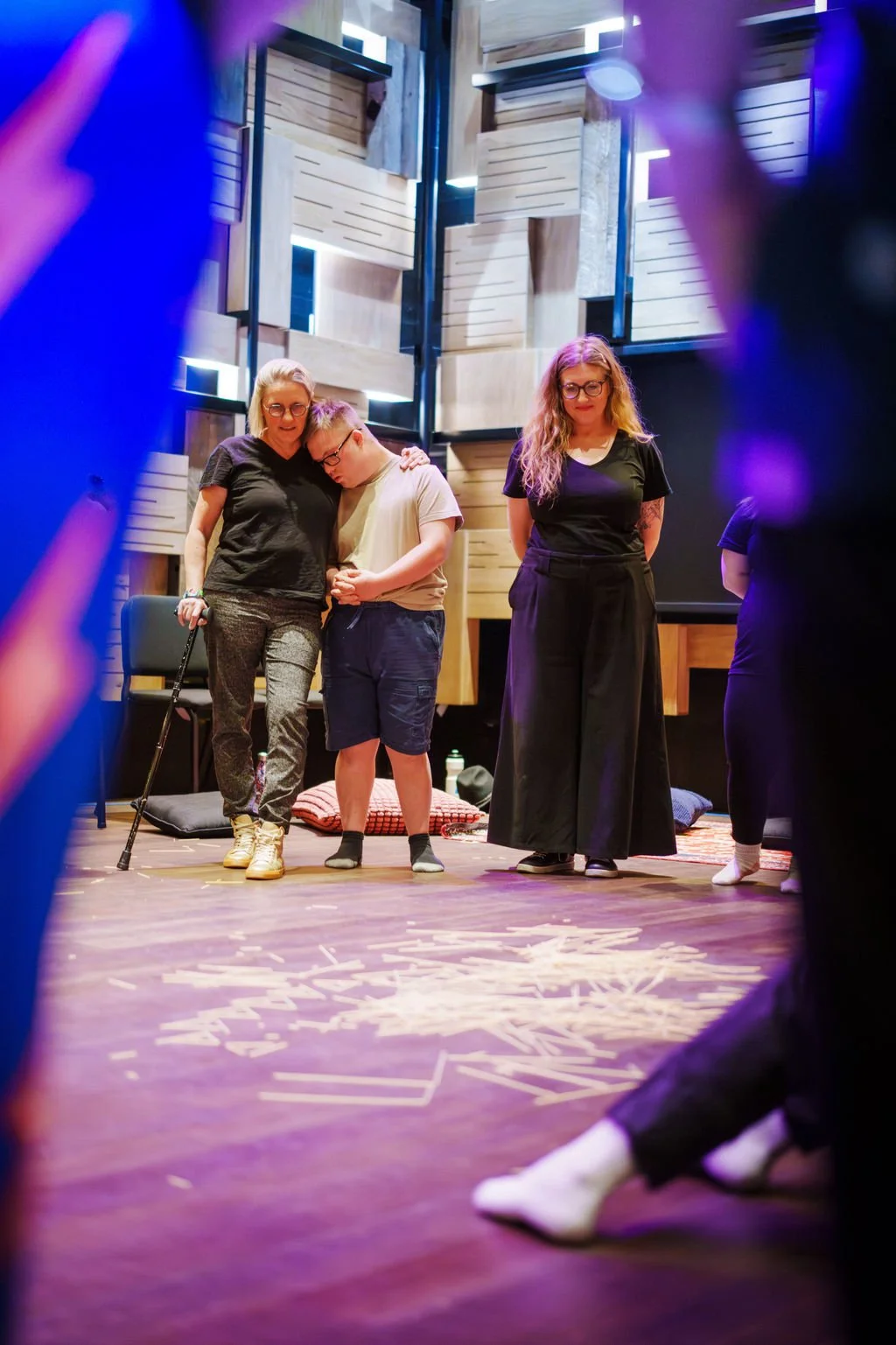
Image description: Three people look toward the ground where there are hundreds of strewn wooden sticks. One woman using a cane puts her arm around a young man, while he rests his head on her shoulder.
Session 4 — National perspectives
Session four widened the lens, connecting Tasmanian practice to the national landscape. Speakers discussed workforce conditions, implementation planning and emerging national networks supporting disabled artists.
A clear message emerged: disabled artists must be involved not only in consultation but in leadership and implementation.
Sarah Heartwood from the Office for the Arts (OFTA) shared updates on Equity: the Arts and Disability Associated Plan, launched in 2024, and reinforced the importance of meaningful engagement with people with disability.
She emphasised:
“…it's important that people with disability are involved in shaping the implementation and the evaluation and the monitoring of Equity. And so we're making sure we do this through paid roles on the Implementation Advisory Group”.
Sarah-Mace Dennis, the inaugural Director of the newly formed organisation Arts & Disability Network Australia (ADNA) also expressed the importance of the long view to influence how we’re working now:
“Our community is central to our existence… we’re really interested in what we will need 5, 10, 15 years from now, and how we can design from the future backwards, to start to put things in motion to call a different future into being.”
This session affirmed that Tasmania’s work is both locally significant and nationally connected.
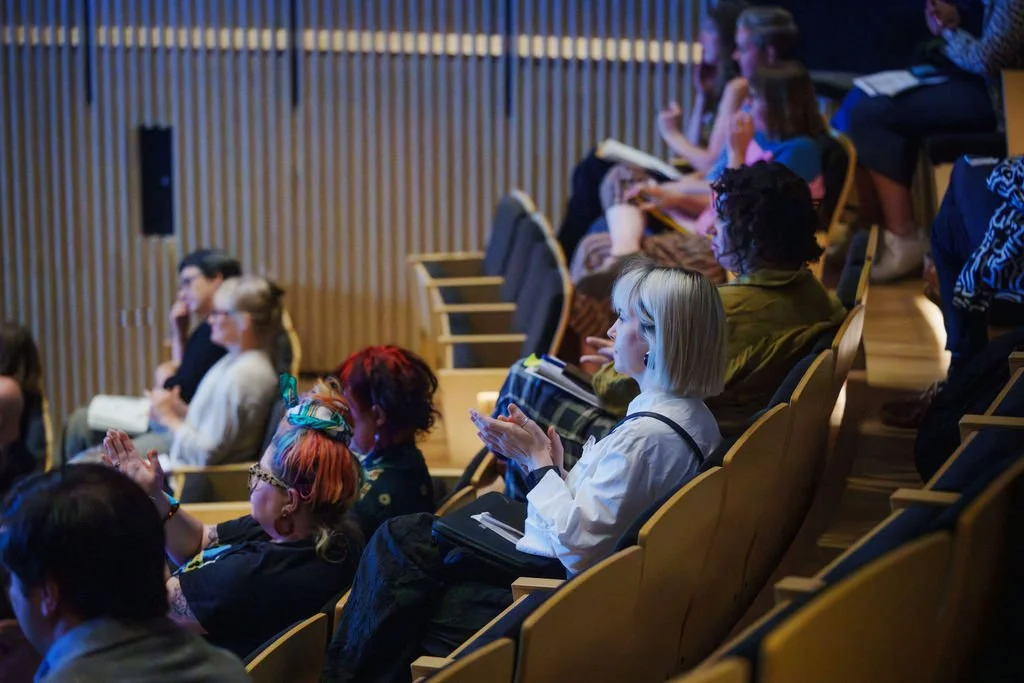
Image description: Audience members sitting in the tiered seated auditorium applaud.
Session 5 — Looking ahead
The final session invited reflections from the steering committee and partners, focusing on what stood out and what comes next. Themes of generosity, leadership and collective responsibility emerged strongly. Laura Sheedy summarised the tone of the day:
“Today has been about empowerment… practical steps… and a whole room filled with generosity and kindness.”
Elise Romaszko’s concise words offered a poetic reflection that resonated across the room:
“Dada. Chaos. Beauty. Radical. Let the art speak.”
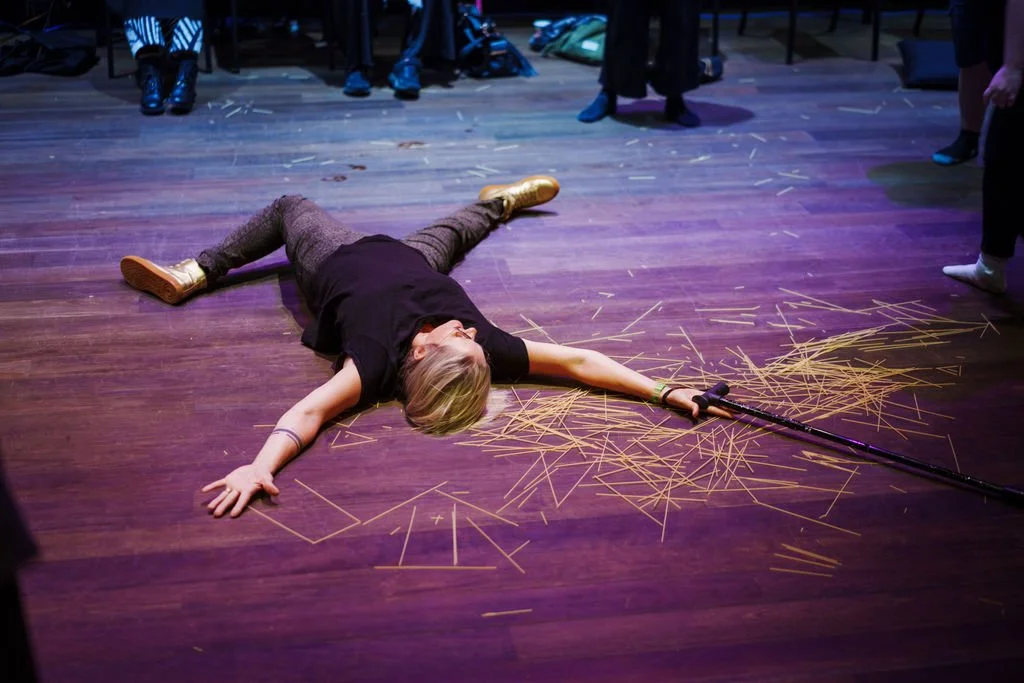
Image description: A person lays spread out on the floor - all limbs outstretched. In her right hand is her cane, and underneath her are hundreds of tiny sticks that looks like dried spaghetti.
Closing reflections
The forum wrapped with words from Kate Mackie, Acting Director of Creative Tasmania and Caine Chennatt, Director of Curatorial and Cultural Collections at UTAS.
Kate reflected on the artistic richness and the practical takeaways the forum offered:
“I have such a long list to take away from today… people calling out when they may have made mistakes helps others feel less afraid to ask questions. Small actions matter, and there are so many good ideas from everyone. It was integral and grounding to have art and makers with disability at the centre — performances like Second Echo’s reminded us of the power of shared human experience, of sadness, joy, humour and terror, and why we do this work.”
Some excerpts from Caine’s closing words of the day offered a powerful synthesis of the day - and a fitting place to leave this reflection:
“Belonging can be hard… not because it isn’t a soft skill, but because belonging is structural.
Equity is not a favour, but a framework — through programs like the Hidden Disabilities Sunflower program, disability access plans, and 365 small wins. Accessibility must be embedded in budgets, contracts, programs, in job ads, in morning teas — everywhere.
Belonging begins now. Belonging is a baseline, not a bonus.
Not necessarily moving fast and not necessarily moving slow but moving at the speed of trust.
Lastly, I have learned about not giving up but giving it a go.”
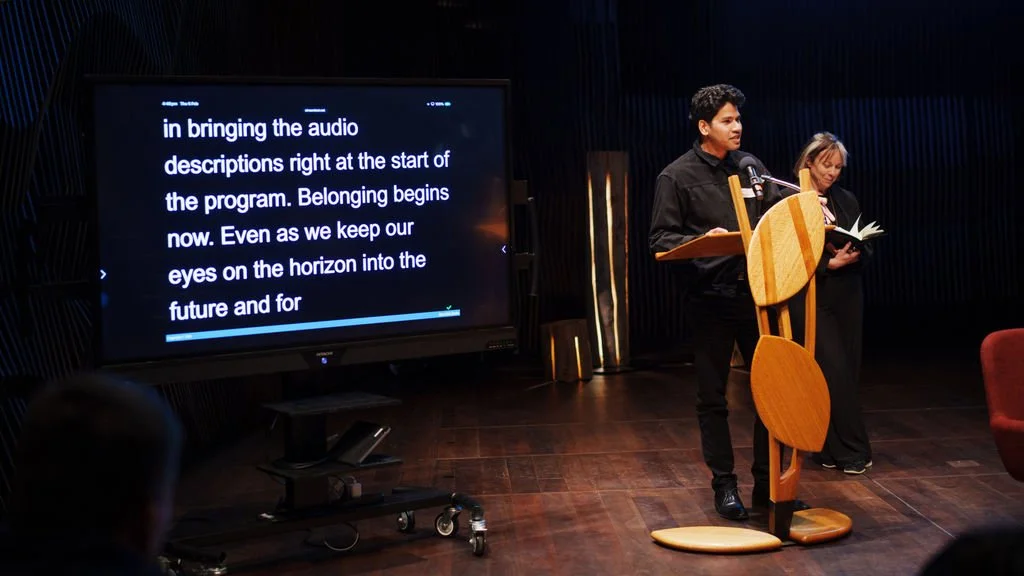
Image description: A man speaking into a microphone at a decorative wooden lecturn. There is a tv monitor with live captioning on screen in the foreground.
What’s next?
As the final outcome of the Building an Artistically Inclusive Tasmania project, this forum demonstrated what is possible when disabled artists are trusted as leaders and when access is treated as an integral part of the arts and artistic excellence.
The conversations held throughout the day helped create a cultural shift and set expectations for what inclusive gatherings can and should look like in the future. This was not a side conversation, but a sold out headline event shaping the future of the sector.
The momentum now sits with all of us: artists, organisations and institutions alike. The work ahead is not about adding extra layers, but about embedding accessibility into the way we already work, create and connect.
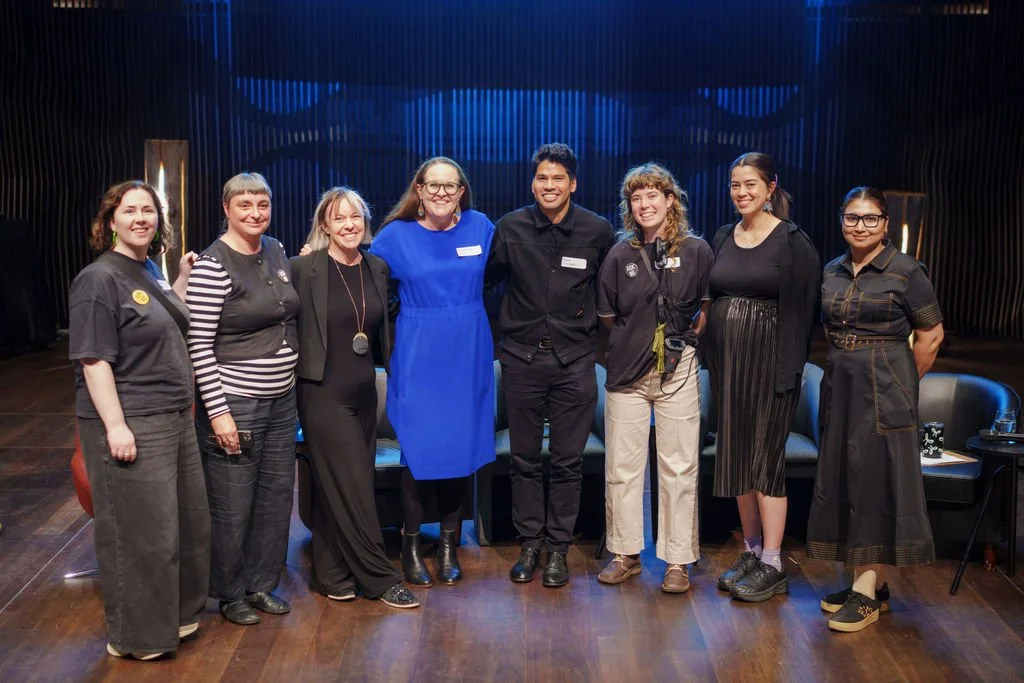
Image description: A group of 8 people stand in a row, smiling at the camera. Morwenna is in the middle wearing a bright blue dress.
Learn more…
Full program and project resources are available at the Arts Tasmania website:
https://www.arts.tas.gov.au/inclusive-arts/from-barriers-to-belonging
Building an artistically inclusive future website:
